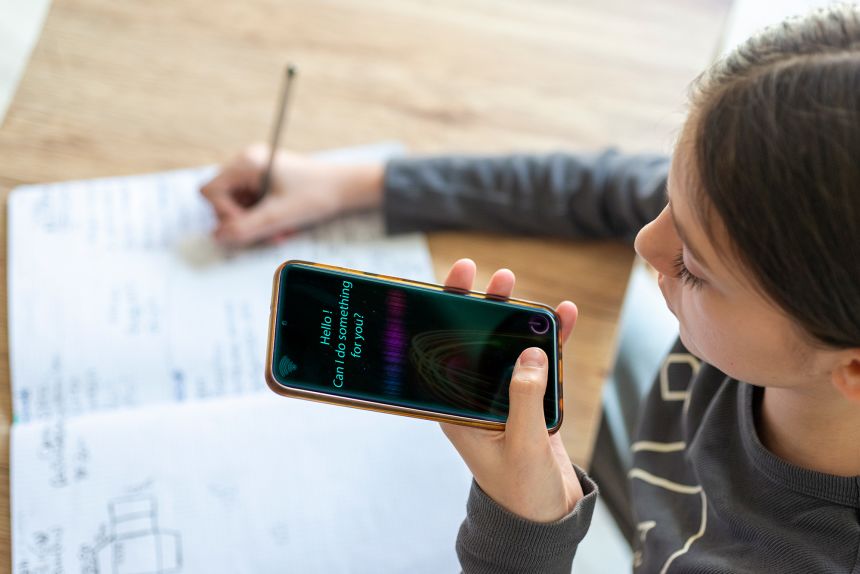
For a child struggling with a difficult maths problem, writing an essay or understanding a science concept, artificial intelligence can seem like the perfect study partner. It is available instantly, never loses patience, and can explain the same concept again and again.
AI is helping children with homework, answering questions, generating ideas and, increasingly, becoming something more personal: a source of advice when they are worried or confused.
That shift is beginning to concern experts not simply because AI can give wrong answers, but because children may begin outsourcing some of the processes of thinking, learning, and emotional processing to machines.
UNICEF said in June that children are adopting AI more than three times faster than adults. Its analysis of data from 10 countries estimated that at least 20 million children had used AI, with about 13 million using it for learning and homework and more than 2 million, one in 10, turning to AI for advice about things that worry them.
The development has pushed child safety and AI regulation higher on the international agenda.
UNICEF warned that children are increasingly turning to AI chatbots not only for information and learning but also for advice, support and sometimes relationships. The advice: shift from reactive regulation to preventive safeguards.
Watch The Podcast https://raisingindia.net/PodcastEpisode?id=6aaed121235212e4d89bab62
AI Interaction is not Intervention.
For Dr Jitendra Nagpal, Director of the Institute of Mental Health and Life Skills Promotion at Moolchand Medicity, Delhi, the issue is not whether children should use AI, but whether they begin to mistake an AI interaction for an intervention. Dr Nagpal is also Program Director at Expressions India, a national life skills and school wellness program for more than two decades.
“AI can be a first-aid tool and a gatekeeper in mental health, but it cannot replace the healing that comes through human-to-human connection.”
That distinction becomes particularly important when a child is anxious, distressed, or struggling emotionally. “A machine can analyse symptoms, but it cannot fully understand the emotional expression, facial cues, distress and vulnerability that emerge in a face-to-face interaction,” says Dr Nagpal.
Two lawsuits have highlighted concerns about potential risks. Parents of 16-year-old Adam Raine, who died by suicide after months of interacting with ChatGPT, claimed AI encouraged him to isolate from his family, failed to flag explicit self-harm inputs, and offered to write his suicide note.
In another case, parents of teenager Sam Nelson, who received dangerous medical/substance mixing advice, and 17-year-old Amaurie Lacey have launched or joined legal actions concerning AI safety protocols and product design involving minors.
An August 2026 review in npj Digital Medicine examining AI chatbots and youth suicide risk said evidence about their safety for managing suicide risk remains poorly understood, with existing studies having important limitations.
The question is not simply whether AI can produce an answer. It is whether a child understands what that answer is — and what it is not.
The problem may begin much earlier than mental health.
Dr Samir Parikh, Senior Psychiatrist and Chairperson of the Mental Health Program at Fortis Healthcare and Adayu Mindfulness, points to a more fundamental question: what happens to cognitive processes that develop through repeated practice if technology increasingly performs those processes for children?
“It’s not merely about problem-solving. It’s also about the processes of the mind. If somebody does something immediately for you, you need to reflect upon whether you are still using your original thought process around it.”
His argument is about practice. “How do you harness a skill? How do you learn something? By using it again and again. How do you work on mental math? If a child continues to use a calculator from day one, would they be able to make basic calculations or not?” Dr Parikh adds.
He applies the same question to digital content.
“If you are watching content which is ultra-short, would you not get more accustomed to having an ultra-short span of attention? If you are doing multiple things, would you not find it difficult to sustain your focus?”
These are not claims that AI has already caused measurable changes in children's brains. They raise questions researchers are only beginning to study as generative AI becomes embedded in childhood.
The evidence on children's long-term cognitive and developmental effects from generative AI is still developing. Research suggests AI can improve learning, but the benefits depend on whether children use it to think better or avoid thinking altogether.
The OECD Programme for International Student Assessment (PISA), which tests 15-year-old students in reading, mathematics and science, shows that 46% of students across OECD countries report using AI chatbots weekly or more to help them learn. PISA 2025 recorded the lowest OECD-average performance so far in reading, mathematics and science.
The OECD does not suggest AI caused this decline. Students who said they did not use AI to draft text for writing assignments performed better than those who did. But among frequent AI users, those taught in school how to assess AI-generated information tended to perform better than students who received no such guidance.
Read More: When I try to put my phone down: A 16-year-old's struggle just before his exams
Is AI doing the thinking — or helping children think?
Dr Nagpal believes the danger comes when AI shifts from being a tool to being a substitute for a child's own cognitive effort.
“We are almost subservient and dependent, and completely, I would say, helplessly looking at every project-based learning for a little bit of an answer. Where is your thinking brain? Where are you stimulating your own cognitive processor?” he said.
His concern isn't that children should never use AI. Rather, he argues that we need to “distinguish between using AI to support thinking and using AI instead of thinking”.
“If somebody, and in this case an algorithm, is giving you an alternative, metacognitive processes will be gone. I will only think through a very limited, telescopic thought process,” he said.
Metacognition — the ability to think about one's own thinking — is particularly important here. A child struggling with an essay has to decide what they know, how to structure an argument, which evidence matters, and whether their conclusion makes sense. AI can help with each step, but it can also do them for the child.
Other countries are moving from debate to safeguards.
Governments are increasingly treating children's interaction with AI as a policy issue.
The European Union's AI framework includes obligations and restrictions around certain high-risk uses, while UNICEF's child-centred AI guidance calls for regulation, child safety, privacy, transparency, accountability and human oversight.
The UK has also moved towards stronger protections. In June 2026, the government announced plans to prevent social-media companies from providing services to under-16s and said further measures would include action on AI chatbots. Its July response proposed additional protections for 16- and 17-year-olds, including overnight restrictions, changes to autoplay and personalised feeds.
G7 digital and technology ministers agreed in June on principles for safer digital spaces for children, including safety and privacy by design, age assurance and recommender systems that prioritise children's safety and wellbeing over engagement.
UNICEF's September 2026 work, based on consultations with children aged 9–17 in five African countries, focuses on the skills children need to navigate an AI-influenced world.
AI literacy may have to become part of health literacy.
For Dr Parikh, education cannot stop at teaching children how to operate AI tools. “Digital literacy, media literacy and AI-related literacy, which also involves these psychosocial aspects, need to become very integral to our education processes.”
Children need to understand the limits of what an AI system is doing — particularly when the interaction concerns health, emotions or personal decisions.
Dr Nagpal similarly sees the answer not in rejecting AI, but in maintaining the hierarchy between human capability and technology.
“AI is a tool that helps human passion, planning and perseverance reach a different level. It should support human intelligence, not replace it.”
His concern is that convenience can gradually become dependence.
“The line is becoming blurred between what we need AI for and what we become dependent on AI for.”
That dependence could have implications beyond schoolwork. “Overdependence on AI can influence emotional regulation, attention span, impulsivity, and our ability to think deeply and plan.”
Human relationships may be the safeguard.
Another dimension is what children lose when technology becomes the default answer to every problem.
Dr Parikh points to social learning, originality and creativity. “My concern about dependence on digital and AI is the neurocognitive aspect — our thinking patterns, our social learning, the impact on our social and peer life, and the impact on the originality of individuals and their creativity.”
He also worries about conformity: “There is also a lot of a herd kind of mentality that some of these aspects bring, where everybody is doing the same thing and churning out the same thing.”
For parents, simply banning AI may not be realistic.
“There is no point comparing the past to now because a year becomes too distant in the past, the way growth and progress is happening all around us,” Parikh says.
Instead, he argues, parents need to remain engaged with the changing environment. “Parenting needs to become a lot more tuned with the times — open and aware of the changes happening. Don’t deny the existence of the various vectors which are impacting young people.”
Dr Nagpal's formulation is similar: AI can assist, but the human relationship cannot simply be automated.
“AI should be a co-pilot, not the driver of human life.”
The question parents and schools now need to ask of every AI interaction is: Is the technology helping the child develop a capability — or quietly taking over the capability itself?
Because the long-term challenge may not be whether children know how to use AI.
It may be whether, while using it, they keep learning how to think, feel, communicate, create, and connect without it.